How to efficiently machine shaped parts on CNC mill-turn machines?
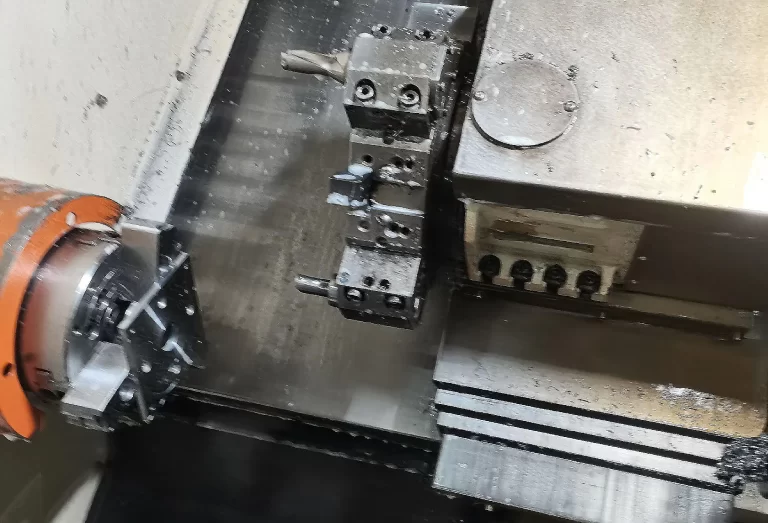


As a new technology adapting to the demands of modern manufacturing for diverse product varieties, small batches, and personalized development, composite machining technology is gaining increasing attention.
It represents one of the key future directions for manufacturing technology.
While this technology can leverage machine tool precision to ensure dimensional and geometric tolerances for precision components, machining large parts like landing gear outer cylinders involves additional factors.
These include machine tool performance and part rotation.
This often leads to significant errors when machining end-face holes.
This paper introduces a method to address such issues and verifies its feasibility through comparative machining tests.
The landing gear’s main outer cylinder measures approximately 800 mm in length.
Technicians machine it using a WFL-M120 turning-milling composite machining center.
The center frame position after precision turning serves as the reference point 4.
Figure 1 illustrates the part structure and center-pin clamping positions.
During actual machining, ensure a single-setup completion to prevent positional errors caused by shifting.
This approach uses the “one clamp, one fixture, one center” method. It guarantees a single clamping and positioning operation.
This enables simultaneous machining of multiple workpiece features using a ring-cutting process.

The three lugs on the end face of the part each have one hole, with all three holes located on the same base circle but distributed at different angles.
The dimensional tolerances and geometric tolerances for the base circle and holes are shown in Figure 2.

Regarding the issues of positional accuracy, base circle dimensions, and coaxiality exceeding tolerances after machining three holes on the end face of the test piece, engineers analyzed and proposed three causes.
They then conducted subsequent verification.
The machining unit of the turning-milling composite machining center consists of multiple components, which introduce geometric errors.
Key influencing factors include the machining unit structure, transmission chain and gear clearance, and motor precision.
Geometric errors in the machining unit reduce workpiece processing accuracy.
**Analysis Verification:** Since technicians calibrated the turning-milling unit before machining, with X, Y, and Z-axis positioning accuracy under 0.01 mm and rotary axis accuracy within 8″, they excluded machine tool geometric errors.
Part asymmetry: When the workpiece rotates to different angles, its center of gravity shifts.
Under center-frame clamping, this displacement combined with the center-frame’s low rigidity causes runout during part rotation.
Analysis and Verification: Technicians positioned three dial indicators at 0°, 90°, and -45° on the center frame to measure radial runout during part rotation.
The dial indicator measurement positions are shown in Figure 3.
Technicians recorded measurements and radial runout values under center support clamping.
These values are listed in Table 1.
When the workpiece is at the initial position (0°), technicians zero all three dial indicators.
As technicians rotate the part to different angles, they record data from the three dial indicators.
Analyzing the recorded data yields the maximum error value, enabling determination of whether the part meets machining accuracy requirements.


Analysis leads to the conclusion that radial runout is minimal in the direction supported by the center frame.
However, it increases significantly in other directions during rotation, causing wobble during part indexing.
The part exhibits high overall rigidity when clamped by centers.
When transitioning from center clamping to center frame clamping, localized displacement occurs in the part.
At the center support position, three dial indicators measured the radial runout of the part.
Measurements were taken when transitioning from center-locked to center-support clamped states at 0°, 90°, and -45° directions (see Table 2).
Technicians set the part’s initial position to 0° and zeroed the three dial indicators while the part was in the center-locked state.

Analysis reveals that when transitioning from center-pin clamping to center-frame clamping, significant deviations occur.
This is the primary source of error in machining end-face holes and represents a common issue in combined turning and milling operations.
After analyzing the causes of errors 2 and 3, engineers proposed the following solutions.
Due to the center support’s inherently lower rigidity, it provides adequate support only in the support direction (machining spindle axis).
Furthermore, the part’s asymmetrical structure inherently causes wobbling during rotation.
Therefore, correcting this error through machine tool structural adjustments—such as altering center support height or tailstock angle—is impractical.
The solution involves measuring the deviation value.
Then, technicians incorporate correction values into the machining program and apply machining compensation to resolve the issue.
Significant deviations occur during clamping state transitions, adversely affecting machining quality at other positions.
Given the tailstock’s superior rigidity compared to the center support, technicians can correct this error by following these steps:
Precisely machining the tailstock.
Using the part’s clamped state against the tailstock as the reference.
Adjusting the center support height, clamping force, and other parameters.
This ensures radial runout fluctuations remain within a minimal range during clamping state transitions.
Through analysis and optimization of machining approaches, engineers have proposed a comprehensive process to achieve high-precision end-face hole machining.
This process utilizes dial indicators for measurement correction and follows these steps:
1. Tailstock correction
2 .Center frame position correction
3. Center frame compensation
4 .Dial indicator measurement correction for end-face hole machining
Finish-turn and finish-grind the tailstock. Measure radial runout with a dial indicator, ensuring it remains within ±0.01mm.
After tailstock clamping, finish-turn the part’s center frame clamping column surface.
Use the machined surface as the reference.
Adjust the center frame height through calibration to compensate for deviations when switching from tailstock clamping to center frame clamping.
This step requires repeated adjustments using a dial indicator at the 0° position of the center frame.
Adjustments continue until the radial runout value displayed by the dial indicator does not exceed ±0.02 mm during state transitions.
Before this step, technicians lathe the center hole of the part to a diameter of D (mm).
The coaxiality tolerance between the center hole and datum 4 is <0.01 mm.
The relative positions of the center hole and the three end face holes can be used to reflect the positional relationship between the three end face holes and datum A.
First, perform rough drilling on the three end-face holes with a drill diameter D1 = 10.0 mm.
Then rotate the part until the centerline connecting Hole 1 and the center hole is parallel to the machine tool’s milling spindle.
Using a dial indicator on the spindle, measure the minimum distance L2 (mm) between the center hole wall and the wall of Hole 1.
The theoretical minimum distance is 1 mm (L1). Given that the base circle diameter D3 = 228 mm, the hole center position deviation Δ1 (mm) is calculated.
A TRANS value is then added to the subsequent reaming program to correct the machining deviation of the hole.
The formula is:
-300x54.jpg "(1)")
In the formula, L1 is the theoretical minimum distance between the center hole wall and hole one wall (mm).
D3 is the base circle diameter (mm);
D2 is the part center hole diameter (mm); D1 is the rough drilling diameter (mm).
.jpg "(2)")
In the formula, Δ1 represents the deviation value of the hole center position (mm).
L1 denotes the theoretical minimum distance between the center hole wall and Hole 1 wall (mm).
L2 indicates the actual measured minimum distance between the center hole wall and Hole 1 wall (mm).
Repeat the above method for the remaining holes to complete the corrective machining.
Gantry-type coordinate measuring machines are typically medium- to large-scale devices, offering sufficient precision for significant components, such as landing gear assemblies.
This machine was used to measure both pre-correction test parts and post-correction production parts.
During conventional machining, the test part was produced solely based on the machine tool’s machining accuracy.
Coordinate measurement yielded the dimensional and geometric tolerances for the three holes, as follows:
1) Hole 1 measured diameter: 10.206mm, positional tolerance relative to reference BC: φ0.151mm.
2) Hole 2 measured diameter: 10.225 mm, positional tolerance relative to reference BC: φ0.140 mm.
3) Hole 3 measured diameter: 10.217 mm, positional tolerance relative to reference BC: φ0.112 mm.
4) The measured diameter of the base circle is 228.907 mm, with a concentricity of φ0.175 mm relative to reference A.
Based on these data, it is evident that without corrective measures, the hole dimensions themselves largely meet tolerance requirements.
However, significant deviations exist in hole position, base circle dimensions, and concentricity, compromising machining quality assurance.
Following all corrections, the dimensional and geometric tolerance data for the three holes in the final production part, measured using a coordinate measuring machine, are as follows:
1) Hole 1 measured diameter: 10.209 mm, positional tolerance relative to datum BC: φ0.025 mm.
2) Hole 2 measured diameter: 10.208 mm, positional tolerance relative to datum BC: φ0.030 mm.
3) Hole 3 measured diameter: 10.217 mm, positional tolerance relative to reference BC: φ0.032 mm
4) Base circle measured diameter: 228.907 mm, coaxiality relative to reference 4: φ0.041 mm
The data confirms that this correction method ensures all three holes meet dimensional and geometric tolerance requirements.
This paper analyzes and verifies the error issues arising in end-face holes during horizontal turning-milling composite machining, proposing a method to correct such errors.
Through practical machining and measurement, the technique of using a dial indicator to adjust the center frame position has been demonstrated as effective.
This method involves measuring hole position deviation values and applying compensation, which successfully corrects errors in end-face holes of significant components during composite machining.
The resulting end-face holes fully comply with the technical requirements specified in the drawings, providing practical guidance for production applications.